Do you need three written warnings before dismissing an employee in Australia?

Many Australian employers believe they must issue three written warnings before terminating an employee’s employment. However, this is one of the most common misconceptions in workplace relations.

The short answer is no. Australian employment law does not require employers to provide three written warnings before dismissing an employee.

Instead, Fair Work considerations generally focus on whether:

  • The employee was made aware of the concerns
  • The employee had an opportunity to respond
  • The employee was given a reasonable opportunity to improve where appropriate
  • The employer followed a fair and consistent process

The number of warnings required will vary depending on the circumstances.

When should an employer issue a warning?

A warning is typically appropriate when an employee’s performance or behaviour falls below expected standards but the issue is not serious enough to justify immediate termination.

An effective warning should clearly outline:

  • The specific concern
  • The expected standard of behaviour or performance
  • The improvements required
  • Any support available to assist the employee
  • The potential consequences if improvement does not occur

The goal of a warning should be to encourage improvement rather than simply create a paper trail.

Performance management: What employers need to know

Performance-related issues commonly include:

  • Failure to meet job expectations
  • Ongoing errors or quality concerns
  • Missed targets or deadlines
  • Lack of productivity
  • Inability to perform key aspects of the role

Where poor performance is identified, employers should clearly communicate concerns and provide employees with a reasonable opportunity to improve.

A documented performance management process can help demonstrate that the employee understood the concerns and had sufficient time and support to address them.

Can you dismiss an employee without any warnings?

Yes, in some circumstances.

An employee may be dismissed without prior warnings where serious misconduct has occurred. However, employers should still conduct an appropriate investigation and allow the employee an opportunity to respond before making a final decision.

For performance-related dismissals, failing to raise concerns and provide an opportunity for improvement can increase the risk of an unfair dismissal claim.

How can employers reduce the risk of unfair dismissal claims?

To minimise risk, employers should:

✅ Clearly communicate concerns

✅ Give employees an opportunity to respond

✅ Provide reasonable support and time to improve

✅ Follow company policies and employment obligations

✅ Keep thorough written records

✅ Seek professional HR or legal advice when necessary

A fair, transparent and well-documented process is often more important than the number of warnings issued.

Frequently Asked Questions

Is the three-warning rule a legal requirement in Australia?

No. Australian employment law does not require employers to issue three written warnings before dismissal.

Can an employee be dismissed after one warning?

Yes. Depending on the circumstances, one warning may be sufficient. Serious misconduct may justify dismissal without prior warnings.

Does a warning need to be in writing?

Not necessarily. However, written warnings provide stronger evidence that concerns were communicated clearly.

What is the purpose of a workplace warning?

A warning is intended to notify an employee of concerns, outline expectations and provide an opportunity to improve.

Disclaimer: This article provides general information only and should not be considered legal advice. Employers should seek professional advice regarding their specific circumstances before taking disciplinary or termination action.

Employee retention strategies: What 20 years in recruitment has taught me about what really makes people stay

If you’re a hiring manager or business leader searching for employee retention strategies in Australia right now, you’re not alone. According to recent industry data, 61% of Australian employees are considering changing jobs this year. That’s more than half your team potentially in play.

But here’s what most listicles on this topic won’t tell you: the strategies that actually reduce staff turnover aren’t the ones that make headlines. They’re quieter than that. And they start long before someone hands in their resignation.

I’ve been placing candidates across the UK and Australian job markets for over 20 years. In that time I’ve had thousands of conversations with people who are moving on and with the employers trying to figure out why. What follows is what I’ve actually observed to work.

Why employee retention in Australia is harder than it looks

The Australian job market has seen significant turbulence since 2022. Quit rates hit decade-long highs. Skills shortages across sectors from construction to professional services put real pressure on employers who couldn’t afford to lose experienced people. And in Queensland particularly, with major infrastructure investment and the Brisbane 2032 Games pipeline building momentum, competition for talent has intensified.

The cost of getting it wrong is significant. Replacing a mid-to-senior level employee in Australia typically costs between 50% and 100% of their annual salary when you factor in recruitment fees, onboarding time, lost productivity, and the knowledge that leaves with them. In a tight labour market, the hidden cost is even higher because that replacement is harder to find and takes longer to hire.

Yet most businesses still treat retention as a reactive problem. Someone resigns. Leadership scrambles. A counteroffer gets floated. And more often than not, the person leaves anyway because the real issue was never the money.

Retention is a leadership problem, not an HR one

The businesses I’ve seen hold onto their best people over the long term share one thing in common: their leaders are genuinely invested in what their team needs – not just what they’re delivering.

That sounds obvious. But in practice, the daily pressure of running a team means real conversations get replaced by performance check-ins. And by the time an employee is sitting across from me exploring a new role, they made the decision to leave months earlier.

The window to do something about it had already closed.

4 employee retention strategies that actually work in Australia

These aren’t theoretical. They’re patterns I’ve observed consistently across Australian businesses – in Queensland and beyond – that genuinely retain skilled people over time.

1. Have real growth conversations – often, not annually

Not the annual review. Not a “check-in” that’s really just a progress update on projects. Actual, ongoing dialogue about where someone wants to go and whether their current role is helping them get there.

LinkedIn research consistently shows that employees who feel they’re developing stay significantly longer than those who feel they’ve plateaued. And yet most employers only have this conversation once a year at best – often in a formal review setting that makes honesty uncomfortable.

High-retention businesses make informal growth conversations a regular habit. Monthly. Quarterly at minimum. They happen over coffee, not in a meeting room with a form attached.

2. Match autonomy to capability

Across thousands of candidate conversations, micromanagement comes up as a driver of departure more consistently than almost anything else. Not just as a frustration – as the reason someone starts looking.

High performers want to own their work. When they’re capable of leading something and aren’t given the room to do it, they find somewhere they can. Autonomy is not just a cultural value – it’s a practical employee retention strategy that costs nothing to implement.

The question worth asking: are your management practices keeping pace with how your people are growing?

3. Give people a visible future

Ambiguity is an underrated driver of staff turnover in Australia. When people can’t see what the next 12 to 24 months looks like for them inside a business, they start looking outside it. Not because they’re unhappy – because they’re uncertain.

Leaders don’t need to have all the answers. But openly discussing what’s possible – what a pathway forward looks like – creates a sense of momentum that people genuinely don’t want to walk away from.

Businesses that do this well don’t wait for someone to ask for a promotion conversation. They initiate it.

4. Recognise people specifically and in the moment

“Good work” is not recognition. It lands as noise.

Pointing out exactly what someone did well, why it mattered to the business, and what it says about their capability – that’s recognition. It’s specific. It’s timely. And it costs nothing except a moment of genuine attention from a leader.

Research from Perkbox’s 2025 Australian workforce report found that recognition and feeling valued remain among the top drivers of employee satisfaction – consistently outranking some financial benefits. The businesses winning on retention have made meaningful recognition a leadership habit, not a quarterly initiative.

What the data tells us about staff turnover in Australia

A few numbers worth knowing if you’re building a retention strategy:

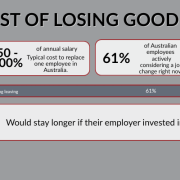
50%–100% of annual salary — the typical cost of replacing an employee in Australia, depending on seniority and role complexity

61% — the percentage of Australian employees currently considering changing jobs (2025)

40 days — the average time to hire in Australia, up from 33 days pre-pandemic, making replacement harder and slower

94% — of employees who say they would stay longer at a company that invests in their learning and development (LinkedIn Learning)

The picture these numbers paint is consistent: retention is a business-critical priority, and the companies getting it right are spending far less time and money on recruitment than those that aren’t.

Frequently asked questions about employee retention in Australia

What is the average employee retention rate in Australia?

Retention rates vary significantly by industry, but Australian businesses across professional services, construction and technology have seen increased pressure since 2022. With 61% of workers currently considering a job change, any retention rate under 85% for specialist roles warrants attention.

How much does it cost to replace an employee in Australia?

Research consistently estimates the cost of replacing an employee at between 50% and 100% of their annual salary. This includes recruitment fees, time to hire (averaging 40 days nationally), onboarding, lost productivity and the knowledge gap left behind.

Why do employees leave a job they like?

Most departures are not triggered by dissatisfaction with the role itself. The more common causes are feeling undervalued, a lack of growth conversations, limited autonomy, and an unclear future within the business. By the time someone starts job searching, the emotional decision to leave has usually been made months earlier.

Do counteroffers work for retaining employees?

Rarely, and usually only in the short term. Industry research suggests most employees who accept a counteroffer depart within 6 to 12 months regardless — because the underlying reasons for considering a move rarely go away. Prevention is far more effective than a last-minute counteroffer.

Thinking about retention in your business?

If you’re a hiring manager or business leader in Brisbane or Queensland and you’re not sure where your team currently stands, start with a simple question: when did you last have a genuine conversation with each of your direct reports — not about a project or a deadline, but about them?

If you’re struggling to remember, that’s probably your answer.

At Elevate Recruitment, we work with businesses across Brisbane, Gold Coast and Queensland at both ends of this challenge — helping teams find great people, and helping leaders think through what it takes to keep them. If you’d like a no-obligation conversation about what retention looks like in your business, we’re always happy to talk.

e: sean@elevaterecruit.com.au

p: +61 7 3556 5126
The other side of working from home: Why going solo can feel a little…Lonely.

There’s no denying the perks of working from home. The commute is a short stroll from the bedroom to the laptop, your lunch is exactly how you like it, and the dress code is  flexible (hello, shorts and t-shirts). For many, it’s the dream setup – especially for those running their own business or working as a sole trader.

But while the benefts of working from home are fantastic, there’s another side that’s not talked about as often – the isolation.

When you’re a sole trader, you’re the boss, the team, and the tea-maker all in one. You celebrate the wins alone, troubleshoot the challenges alone, and sometimes, you go a whole day without speaking to another person (unless you count the courier who dropped off your parcel or your ever faithful fur-baby). The lack of casual office banter, social interaction, and even the morning coffee chat can really start to show after a while.

The irony is, while remote work offers flexibility and independence, it can also make you feel a bit stuck – physically and mentally. The same four walls, day after day, can start to dull the excitement that once came with being your own boss.

That’s why it’s important to find ways to bring connection back into your work life. Whether it’s joining professional networks, setting up virtual catch-ups with peers, meeting a supplier for coffee or simply taking your laptop to a café – little shifts can make a big difference.

At Elevate Recruitment, we speak to many professionals who love the freedom of remote work but miss the connection of the workplace. Finding that balance between autonomy and connection, can be the key to long-term happiness and success in your career.

Because yes, working from home can be wonderful… but we all need a bit of laughter, energy, and shared experience to keep us feeling inspired.

Would you agree? Do you find yourself missing the office buzz?

If you’re not getting what you need from your job – take a browse at our job board to see if there if we can help you find a role that gives you both the flexibility you love and the connection you’ve been missing.

Ace your job interview: Our top tips

Landing a job interview is an exciting milestone in your career journey. It’s your chance to stand out, highlight your skills, and show why you’re the best candidate for the role. But it’s also the stage where preparation and confidence are key to success. At Elevate Recruitment, one of Queensland’s leading recruitment agencies, we know […]

Our top 5 non-financial benefits to retain employees when a pay rise isn’t an option

Retaining top talent is critical for business success, but what if offering a pay rise isn’t feasible? In the current market, non-financial benefits can be effective in keeping employees engaged and motivated. Our blog post explores our Top 5 non-financial benefits that can help retain employees and improve job satisfaction, even when salary increases aren’t […]

New employment laws: What you need to know about the Right to Disconnect

August 25, 2024, several significant changes to employment laws have come into effect, reshaping the way businesses and employees interact. The introduction of the “Right to Disconnect” for employees of non-small businesses (that is a business employing 15 or more employees) will apply from today. Understanding the Right to Disconnect The Right to Disconnect is […]

Out of office response tips

Taking some time off for a holiday or heading out on a work trip? An Out of Office (OOO) message is a must for letting your clients, suppliers, and colleagues know you’re away from your desk. Writing an Out of Office message might seem pretty easy, but anyone who has sat there with a blank […]

Navigating Australia’s job market in a cooling economy: strategies for success

Australia has long been renowned for its vibrant economy and robust job market, attracting both local talent and skilled professionals from around the globe. However, recent economic indicators for 2024 suggest a cooling trend, presenting challenges for job seekers and employers alike. In this post, we explore the current state of Australia’s job market amidst a cooling economy and look at strategies for navigating uncertain times.

In recent years, Australia has experienced steady economic growth fueled by factors such as a booming resource sector, robust construction activity, and strong domestic consumption. However, several factors have contributed to a slowdown in economic momentum, including global economic uncertainties and international political tension.

The impact of this cooling economy is felt across various sectors, with job creation slowing down and unemployment rates edging up. Industries heavily reliant on consumer spending, such as retail and hospitality, have been particularly affected, while sectors like manufacturing and construction are also facing challenges due to lower investment and weaker demand.

Challenges for Job Seekers: For job seekers, navigating the current job market presents unique challenges. With job opportunities starting to slow and increased competition for roles, securing employment can be more challenging than during periods of economic growth. Additionally, uncertainty surrounding the future of the economy may lead to hesitation among employers to make new hires or expand their workforce.

Strategies for Success: While the job market may seem more challenging in a cooling economy, there are several strategies that job seekers can use to enhance their prospects:

  1. Diversify your skillset: In a competitive job market, having a diverse skillset can set you apart from other candidates. Consider acquiring new skills or certifications that are in demand across multiple industries.
  2. Network effectively: Networking remains one of the most powerful tools for finding job opportunities, even in a challenging economic environment. Attend industry events, join professional associations, and leverage online platforms like LinkedIn to connect with potential employers and industry peers.
  3. Be flexible and adaptable: Flexibility is key during uncertain times. Be open to exploring opportunities outside your usual scope or industry, and demonstrate your ability to adapt to changing circumstances.
  4. Upskill through education: Consider pursuing further education or professional development courses to enhance your qualifications and stay competitive in the job market. Many institutions offer flexible online learning options that allow you to upskill while balancing other commitments.
  5. Stay resilient and persistent: Job searching can be a rollercoaster of highs and lows, especially in a challenging economic climate. Stay resilient, remain persistent, and don’t be discouraged by setbacks. Every rejection brings you one step closer to your next opportunity.

While Australia’s job market may be facing headwinds with a cooling economy, there are still opportunities for those who are proactive, adaptable, and resilient. By understanding the current landscape, leveraging effective strategies, and remaining persistent in your pursuit of employment, you can increase your chances of success in today’s competitive job market.

Recruitment trends in Australia: 2023 review and a glimpse into 2024

As 2023 moves into Q4, the recruitment landscape in Australia has undergone significant transformations. The past year has been marked by new challenges and opportunities, shaping the way organisations approach talent acquisition. As we prepare for 2024, we reflect on the trends that have dominated recruitment in Australia in 2023 and anticipate what the future holds. In this post, we will explore the key recruitment trends of 2023 and provide insights into what we can expect in 2024.

Emphasis on Diversity and Inclusion
Diversity and inclusion have been at the forefront of recruitment trends in Australia throughout 2023. Companies have recognised the importance of building diverse teams to foster innovation, enhance workplace culture, and cater to a multicultural customer base. In 2024, we can expect this trend to intensify, with organisations proactively focusing on building more inclusive recruitment practices and fostering an equitable workplace.

Hybrid and Remote Work
The pandemic accelerated the shift towards remote work, and in 2023, many organisations adopted a hybrid work model. This change has implications for recruitment, as it broadens the talent pool. In 2024, we anticipate that hybrid and remote work opportunities will continue to be a major consideration for both candidates and employers, leading to a more globalised approach to talent acquisition.

Upskilling and Reskilling
The rapid pace of technological advancements and evolving job roles have made upskilling and reskilling a central theme in 2023. Companies are increasingly investing in employee development programs to retain and grow their existing talent. In 2024, we expect this trend to intensify, with employers prioritising the development of their workforce to meet the demands of a changing job market.

Data-Driven Recruitment
The adoption of data-driven recruitment tools and technologies has gained significant momentum in 2023. These tools provide valuable insights into candidate sourcing, selection, and retention. In 2024, this trend will continue to evolve, with the integration of artificial intelligence, predictive analytics, and machine learning to make more informed hiring decisions.

Green and Sustainable Recruiting
Environmental sustainability and corporate social responsibility have become essential factors for job seekers in 2023. Companies that prioritise sustainability not only attract top talent but also align themselves with growing public awareness of climate change. In 2024, we can expect more organisations to incorporate sustainability into their employer branding and recruitment strategies.

Candidate Experience
A positive candidate experience remains a critical aspect of recruitment in 2023, with candidates expecting a smooth and respectful hiring process. In 2024, organisations will invest more in creating a seamless, candidate-centric recruitment experience, leveraging technology and feedback to continuously improve their processes.

AI-Powered Recruitment
Artificial intelligence is becoming increasingly integral to the recruitment process. AI tools can help automate routine tasks, screen candidates, and improve the overall efficiency of the hiring process. In 2024, we can anticipate further advancements in AI recruitment solutions, streamlining the recruitment workflow and enhancing candidate matching.

Conclusion

Recruitment trends in Australia in 2023 have reflected the evolving needs of the job market and workforce. Diversity, remote work, upskilling, data-driven recruitment, sustainability, candidate experience, and AI-powered tools have all played a significant role in shaping the recruitment landscape. As we look forward to 2024, it’s clear that these trends will continue to evolve and influence the way organisations attract and retain top talent. To stay competitive, employers and recruiters must adapt and embrace these changes to navigate the dynamic world of recruitment successfully. Elevate Recruitment is committed to staying at the forefront of these trends, ensuring that our clients and candidates benefit from the latest insights and innovations in the recruitment industry. We are excited to continue supporting your recruitment needs in 2024 and beyond, helping you navigate the ever-changing landscape of talent acquisition in Australia.