
Interview dos and don’ts for employers

Interviews…a crucial element in the recruitment process. If you don’t make a candidate feel at ease you may not get the best from them and miss an outstanding hire. If you don’t dig deep enough and you may find that the candidate is looking to use your role as a stepping stone to somewhere else.

We’ve lost count of the number of job interviews we’ve undertaken here at Elevate Recruitment. We’ve pulled together a list of our top dos and don’ts of the interview process for employers.

Dos: 

  1. Establish a rapport with the candidate. Make them feel at ease so they are comfortable as they can be during the interview process, you’ll be more likely to see the ‘real’ person to establish if they’re a good fit for your team.
  2. Be positive. Although it is important to be realistic when describing the nature of the role, make sure you’re ‘selling’ the company and promoting the positive things the business has achieved and the great things they can expect as part of the role – whether that be the amazing team they’ll be working with or perks or benefits offered by the company.
  3. Allow a realistic schedule. If you have a number of candidates you’re interviewing for the same role make sure you allow enough time for the interview as well as additional to cover any questions the candidate may have. Also, allow enough time so no one is waiting for another interview to wrap up – each candidate wants to feel special.  If you make them feel like just a number it won’t leave a good impression of your company.
  4. Use open-ended questions. How, what, when, why – for example – Tell me about a time when a project you were working on did not go to plan. What did you learn from this experience? Open-ended questions encourage the candidate to open up and talk, prompting them to go into more detail if necessary. The last part of this question we think is key – everyone makes mistakes, it’s how we learn. You want to know that the candidate has learned from their mistakes and what they do now to avoid making the same mistake over and over.
  5. Use criteria to compare candidates. Decide what the key competencies are prior to a series of interviews. Evaluate your interview notes and if necessary mark candidates on each competency, especially if your interviews are spread out over several days.
  6. Thank candidates for their time. Candidates often have to take time off to attend interviews, some travel long distances, and some put in hours preparing for the interview. Even if they are not successful in getting the role, if you show appreciation for their time and give constructive feedback (if asked for), this will leave them with a positive impression of your company.

Don’ts:

  1. Be unprepared – especially if you are running a series of interviews. To make it easier to compare candidates each candidate should be asked the same (or very similar) question that covers one of your key competencies. Top candidates will see if you’re unprepared and you’ll come across as unprofessional.
  2. Spend more time talking than listening. You are there to find out as much as you can about a candidate in a short space of time. A potential employee wants to leave the interview feeling like they’ve had a great opportunity to present themselves in the best way possible – not leave feeling like they couldn’t get a word in sideways.
  3. Don’t ask unprofessional questions – including about the potential employee’s race, religion, age, marital status and sexual orientation.
  4. Don’t speak negatively about the company or co-workers. You do not want to create doubt in the mind of a potential employee because of something negative said about the company or a co-worker at an interview. Remember top candidates will be in the running for more than one role – they are as much interviewing you as you are them.
  5. Don’t over-promise. Be honest and avoid making false promises on job details in regard to salary expectations, career prospects, employee benefits and other job details as this will leave you in a no-win situation.

We can help you pre-screening, providing you with a short list of candidates that we know can do the role – leaving you to decide which one is the best fit for your company. Not finding the right candidate costs time and money, our goal here at Elevate Recruitment is to make sure you get the right person for your team. We’re so confident in our ability to do this that we offer a candidate guarantee.*

*If your new staff member doesn’t work out for any reason during the agreed timeframe, we’ll find a replacement at no extra charge. Ts and Cs apply. Contact sean@elevaterecruit.com.au for more details. 

Workplace trends we can expect in 2023

As we move into 2023, we’ll see new workplace trends and the continuation of trends that emerged in 2022. We’re three years on from the start of the pandemic which changed the workplace in many ways. New approaches to work location and employee retention, as well as changes in technology, will drive continued changes to workplace trends. How you as an employer respond to them could determine whether you’re an employer of choice.

Here are some trends to look out for:

1. Focus on flexibility

We’re no longer driven by the necessity for remote working like we were during the pandemic, however, for many employees remote working (or at least the option to work remotely for at least part of the work week) is now a requirement when considering a new job role. Many companies will continue to experiment with different forms of remote and hybrid working or as a minimum, flexibility for those on the frontline where remote working is not an option eg stability in work schedule or control over work schedule. A survey by Omdia found that 54% of survey respondents believe working from home has increased productivity. In contrast, companies like Tesla have made news by forcing all employees to return to the office.

2. Talent shortages and skills gaps

Hiring is difficult in the current labour market but many organisations are further challenged by severe talent shortages in critical areas. Around three-quarters of companies currently hiring have reported finding qualified applicants difficult for certain positions ranging from construction to technology. Savvy companies will work to improve upskilling and reskilling to retain staff in 2023.

3. Ongoing hiring and retention challenges

Continuing from #2 workers continue to leave their jobs at higher-than-usual rates. The gap between the number of people seeking work and the number of job vacancies remains wide – making employee retention highly important.

4. A focus on skills over jobs

In this environment, we can’t stress enough how employees should be looking at what skills employees can bring to the table rather than their previous roles. Many valuable skills like sales, project management experience or data analysis can be applied to many different roles. An increase spend on in-house upskilling will help retain staff and fill gaps in the labour market.

5. Soft skills

This is a trend we’ve seen over recent years, soft skills were important before the pandemic but the need to build relationships virtually and made them even more important. Soft skills that are always in demand are management and leadership skills, creativity, and problem-solving.

6. Transforming HR with technology and data

Many companies are turning to cloud computing, collaboration technology and digitisation to improve the employee experience, recruitment experience and HR operation.

7. Use of AI and automation

Along with automation technology, AI offers growth opportunities for companies if they’re prepared to take them on. As these opportunities unlock companies will need to invest in upskilling employees to work with these technologies.

8. Continued focus on sustainability

Demand for sustainability practices is being driven by the consumer. For many organisations embracing sustainability practices will require investment and employee upskilling to improve the company’s environmental footprint.

As workplaces continue to evolve in 2023 it’s clear the pandemic (among other factors) has driven workplace change at a rapid pace and employers need to make sure they keep up and upskill employees more than ever before.

Minimum wages increased July 2022

National award wage increases

The Fair Work Commission handed down a 5.2% increase to the National Minimum Wage effective from 1 July 2022.  What does that mean for you as an employer? Here are some key things to keep in mind:

  • The national minimum wage now sits at $21.38 per hour (up from $20.33) or $812.60 per week (up $40 from $772.60) based on a 38-hour week for a full-time employee. This increase applies from an employee’s first full pay period on or after 01 Jul 2022.
  • Casual employees entitled to the national minimum wage must receive a minimum $26.73 per hour, which includes their 25 per cent casual loading.
  • The increases to award wages will happen in two stages, with most award wages increasing from 1 July 2022. For 10 awards in the aviation, hospitality and tourism industries, the increase will start on 1 October 2022.
  • Businesses can use the Fairwork Pay & Conditions Tool to check the minimum pay rates that they need pay their staff.
  • Employers also need to increase superannuation contributions to 10.5% effective 1 Jul 2022.

If employers or employees have any questions about pay rates, they can contact the Fair Work Ombudsman for free advice and assistance.

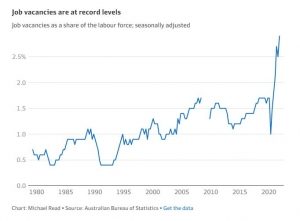
Job vacancies at record levels

Latest data from the Australian Bureau of Statistics show the unemployment rate is at its lowest level in almost 14 years with 13.4 million people in employment and 563,300 people unemployed.  Job vacancies as a share of the labour force are at record levels.

The level of job vacancies in February 2022 was 86% higher than in February 2020, prior to the start of the pandemic. The ongoing high level of vacancies reflects the pace of recovery in labour demand from the fall in May 2020, as well as businesses across the economy indicating labour shortages and ongoing disruptions to operations.

Combined with very limited immigration during COVID, this may explain why many businesses are finding it hard to recruit skilled workers.  If you’re having trouble finding the right people to join your team – get in contact with us to see if we’re the right fit for you.  sean@elevaterecruit.com.au

Great news for job seekers

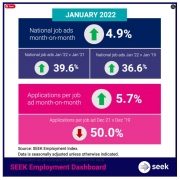
Recent stats released by SEEK for January 2022, show positive news for job seekers looking to take the next move in their careers.

National job ads are up 40% for Jan 2022 vs Jan 2021 and up 37% vs 2019 (pre-COVID). The job market in Victoria is looking particularly strong with an increase of 47% for Jan year on year, followed closely by New South Wales with an increase of 45% and Queensland’s job ads increasing 38%. ACT showed the lowest growth of 12% vs Jan last year.

And another bonus for job seekers, applications per role are down a massive 50% on average.

source: SEEK employment dashboard Jan 2022


Why use a recruitment agency to fill your job vacancy?

There are many different recruitment agencies or talent acquisition agencies – all offering a variety of services, methods, and fee structures. If you have a job vacancy in your team, you may consider working with an agency to help or you might wonder where you would begin to find the right agency.

Why do I need a recruitment agency?

Recruitment is a time-consuming process and if undertaken by core staff it keeps them from performing their actual job. If the wrong candidate is taken on it can cost the business in multiple ways:

  • Time – already spent on the failed recruitment drive and having to repeat the process
  • Resource – from the people or team who spent time with the failed candidate
  • Success – the people or team may not have performed to expectations while under-resourced

 An ethical recruitment agency has the skills, experience, systems, and knowledge to:

  • effectively find a skilled candidate matching your requirements
  • find them efficiently, saving you time pouring over CVs
  • understand your company’s culture to find a candidate who will ‘fit’ the culture
  • free up your core staff to focus on their core role
  • find you a highly skilled candidate who may not have been actively looking for a new role

Minimise the risk

An important advantage of using a recruitment agency is that reputable agencies offer you security when it comes to retaining the new candidate by offering you a guarantee period. Elevate Recruitment reassures our clients by offering a replacement guarantee period* means if the candidate doesn’t work out or leaves within a set period of time, we’ll offer you a free replacement.

What makes a great recruitment agency?

Clear process – Not all agencies work the same way so it’s important your recruiter takes the time to understand you and your company. They should explain the process step by step so both parties are clear on how it will work and what is expected from each party.

Personable – You should look at your agency as an extension of your team, so your recruiter should be personable, approachable and genuinely interested in your company.

Longevity – Find out how long the agency has been in business and how much experience the recruiter has. Experienced recruiters have had the time to build up long term relationships with clients and candidates – which helps the process flow more smoothly.

Responsive – Ideally you’ll have a dedicated point of contact at the agency and they’ll make time for you, returning calls promptly or replying to emails quickly.

In summary, a great recruitment agency will help you recruit and retain the right candidates faster and, in a cost, effective way and stress-free way.

*Ts and Cs apply please ask us for more details.

Answering tricky questions – Part 3: Where do you see yourself in five years?

For some of us, the ‘goal-setting, love-to-plan years in advance’ types – this question is easy, as you’re always thinking, and in some cases writing down your short-term and long-term goals. For the rest who don’t know what’s for dinner tonight, let alone what you’ll be doing in five years, this question may bring you out in a cold sweat.

So, what are interviewers really wanting to know by asking this question?

They’re looking to find out if this role and company will satisfy you – that your goals are in line with what the company can offer, that you’ll work hard and stay with the company for an extended period. They’re also looking to find out how driven you are and how far you might want to progress.

So how do you approach this question?

Make sure you’ve done some research on the company and the position.  By understanding the type of person they’re looking for and the company culture, you can show you understand what is needed to be successful in the role.

If you are likely to need to learn skills or gain a qualification to be successful in the role, show that you understand the work that will be involved, and how long it will take and reassure them that you’re up for it.

Right:

  • You want to give the hiring manager the impression that you’re content with the position as is. But you should also express enthusiasm about developing in a realistic way. 
  • If you plan to retire in five years, give a response that focuses on how you’ll develop your skillset within the position.
  • Most of all express enthusiasm! If you can’t be enthusiastic before you’ve started, then it will raise a red flag.

Example:

“I’m really excited by this position at Upward Digital because in five years, I’d like to be seen as an expert in SEO, and I know that’s something that I’d have the opportunity to do here. I’m also keen to take the lead in some projects in the next few years. I’ve been lucky enough to work with some amazing project managers, and so developing into a great project manager myself is something I’m really excited about.”

Avoid

  • Being flippant. This is not the time to say you hope to win Lotto and be retired, on a beach drinking pina coladas.
  • Telling the interviewer that you plan to have their job in five years. And this isn’t the time to say you plan to be CEO (unless of course you are applying for a CEO position.)
  • Talking about side projects even if that might be where your dream job might lie.  Eg. “In my spare time I’ve started developing an app – I’ve been working on it for a year now and it’s almost done. That’s where my real passion lies and one day, I’d like to do this full time”.